
Tackling Real Estate topics that you care about in Lansing, Grand Ledge, Holt, Mason, Dimondale, Eaton Rapids, Williamston, East Lansing, Haslett, Okemos, and St. Johns.
Monday, April 3, 2023


Saturday, April 1, 2023
Your Tax Refund Can Help You Achieve Your Home buying Goals
Have you been saving up to buy a home this year? If so, you know there are a variety of expenses involved – from your down payment to closing costs. But there’s good news – your tax refund can help you achieve your goals by paying for some of these expenses.
SmartAsset estimates the average American will receive a $1,798 tax refund this year. The map below provides a more detailed estimate by state:

According to Freddie Mac, there are multiple ways your refund check can help you as a homebuyer. If you’re getting a refund this year and thinking about buying a home, here are a few tips to keep:
- Saving for a down payment – One of the largest barriers to homeownership is saving for a down payment. You could reach your savings goal more quickly than expected by using your tax refund to help with your down payment.
- Paying for closing costs – You have to pay fees to your lender, real estate agent, and other parties involved in the homebuying transaction before you can officially take ownership of your home. You could direct your tax refund toward these closing costs.
- Lowering your interest rate – Your lender might give you the option to buy down your mortgage interest rate during the homebuying process. That means, you could pay upfront to have a lower interest rate on your fixed-rate mortgage.
The best way to prepare to buy a home is to work with a trusted real estate professional who understands the process. They’ll help you navigate the costs you may encounter as you begin your homebuying journey.
Bottom Line
Your tax refund can help you reach your goals of homeownership. Connect with a local real estate agent to discuss how you can start your journey today.
Thursday, March 16, 2023
4 Key Tips for Selling Your House This Spring
Spring has arrived, and that means more and more people are getting their homes ready to sell. But with recent shifts in real estate, this year’s spring housing market will be different from the frenzy of the past several years. To sell your house quickly, without hassles, and for the most money, be sure to follow these four simple tips:
1. Make Sure You Give Buyers Access
One of the biggest mistakes you can make as a seller is limiting the days and times when buyers have access to view your home. In any market, if you want to maximize the sale of your house, you can’t limit potential buyers’ access to view it. If it’s not accessible, it could cost you by sitting on the market longer and ultimately selling for a lower price.
2. Make Your Home Look as Good as Possible on the Inside
For anything to sell, especially your home, it must look inviting. Your real estate agent can give you expert advice on ideal staging for your home. Even updating a room with fresh paint, steam cleaning carpets, or removing clutter from the garage can make a big impact.
3. First Impressions Matter
The old saying “you never get a second chance to make a first impression” matters when selling your house. Often, the first impression a buyer gets is what they see as they walk up to the front door. Putting in the work in on the exterior of your home is just as important as what you stage inside. Freshen up your landscaping to improve your home’s curb appeal so you can make an impact with potential buyers.
4. Price It Right
This is probably the most important aspect of selling your home in today’s real estate market. If a house is priced competitively, it’s going to sell. Period. To do this, you have to know what’s happening with home prices in your area and understand the factors that are affecting the market right now. That’s why it’s best to work with a trusted real estate professional who can ensure you list your house at the right price.
Bottom Line
Everyone selling their home wants three things: to sell it for the most money they can, to do it in a certain amount of time, and to do all of that with the fewest hassles. To accomplish these goals, start by connecting with a local real estate professional to understand the steps you need to take to sell your home this spring.
Wednesday, March 8, 2023
Get Ready: The Best Time To List Your House Is Almost Here
If you’re thinking about selling this spring, it’s time to get moving – the best week to list your house is fast approaching.
Experts at realtor.com looked at seasonal trends from recent years (excluding 2020 as an uncharacteristic year due to the onset of the pandemic) and determined the ideal week to list a house this year:
“Home sellers on the fence waiting for that perfect moment to sell should start preparations, because the best time to list a home in 2023 is approaching quickly. The week of April 16-22 is expected to have the ideal balance of housing market conditions that favor home sellers, more so than any other week in the year.”
If you’ve been waiting for the best time to sell, this is your chance. But remember, before you put your house on the market, you’ve got to get it ready. And if you haven’t started that process yet, you’ll need to move quickly. Here’s what you should keep in mind.
Work with an Agent To Determine Which Updates To Make
Start by prioritizing which updates you’ll make. In February, realtor.com asked more than 1,200 recent or potential home sellers what updates they ended up making to their house before listing it (see graph below):
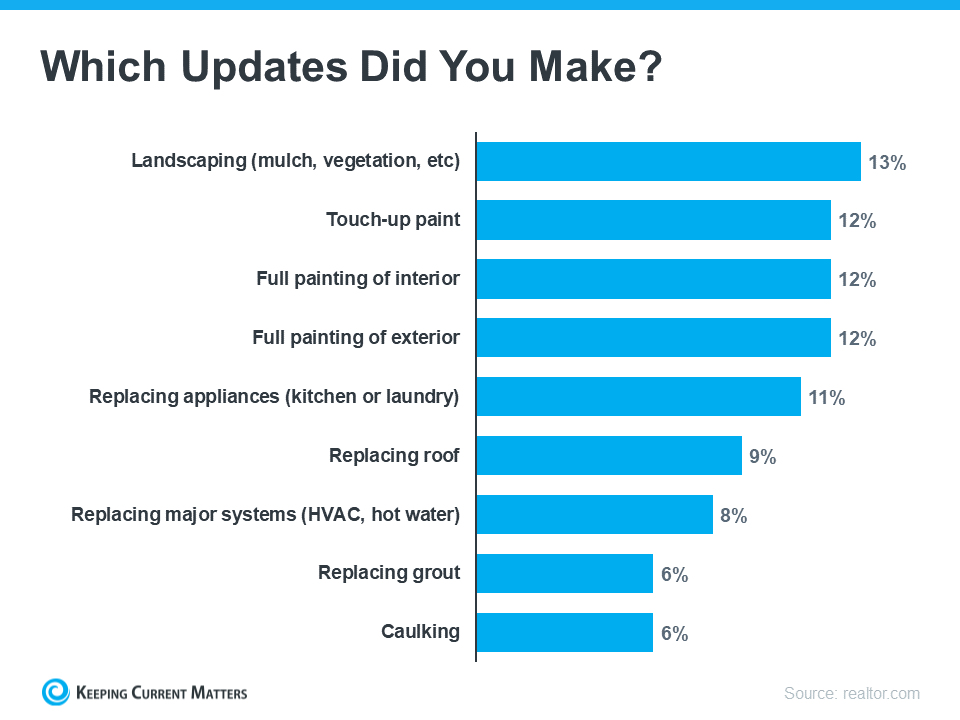
As you can see, the most common answers included landscaping and painting. Work with a trusted real estate agent to determine what projects make the most sense for your goals and local market.
If Possible, Plan To Have Your House Staged
Once you’ve made any necessary repairs and updates to your house, consider having it staged. According to the National Association of Realtors (NAR), 82% of buyers’ agents said staging a home made it easier for a buyer to visualize the property as a future home. Additionally, almost half of buyers’ agents said home staging had an effect on most buyers’ view of the home in general. Homes that are staged typically sell faster and for a higher price because they help potential buyers more easily picture their new life in the house.
Bottom Line
Are you ready to sell this spring? Contact a real estate agent to plan your next steps. You can start by making a checklist of what you think your house needs to get ready. Then, we can work together to prioritize your list and move forward together.
Thursday, February 16, 2023
What You Should Know About Closing Costs
Before you buy a home, it’s important to plan ahead. While most buyers consider how much they need to save for a down payment, many are surprised by the closing costs they have to pay. To ensure you aren’t caught off guard when it’s time to close on your home, you need to understand what closing costs are and how much you should budget for.
What Are Closing Costs?
People are sometimes surprised by closing costs because they don’t know what they are. According to Bankrate:
“Closing costs are the fees and expenses you must pay before becoming the legal owner of a house, condo or townhome . . . Closing costs vary depending on the purchase price of the home and how it’s being financed . . .”
In other words, your closing costs are a collection of fees and payments involved with your transaction. According to Freddie Mac, while they can vary by location and situation, closing costs typically include:
- Government recording costs
- Appraisal fees
- Credit report fees
- Lender origination fees
- Title services
- Tax service fees
- Survey fees
- Attorney fees
- Underwriting Fees
How Much Will You Need To Budget for Closing Costs?
Understanding what closing costs include is important, but knowing what you’ll need to budget to cover them is critical, too. According to the Freddie Mac article mentioned above, the costs to close are typically between 2% and 5% of the total purchase price of your home. With that in mind, here’s how you can get an idea of what you’ll need to cover your closing costs.
Let’s say you find a home you want to purchase for the median price of $366,900. Based on the 2-5% Freddie Mac estimate, your closing fees could be between roughly $7,500 and $18,500.
Keep in mind, if you’re in the market for a home above or below this price range, your closing costs will be higher or lower.
What’s the Best Way To Make Sure You’re Prepared at Closing Time?
Freddie Mac provides great advice for homebuyers, saying:
“As you start your homebuying journey, take the time to get a sense of all costs involved – from your down payment to closing costs.”
Work with a team of trusted real estate professionals to understand exactly how much you’ll need to budget for closing costs. An agent can help connect you with a lender, and together your expert team can answer any questions you might have.
Bottom Line
It’s important to plan for the fees and payments you’ll be responsible for at closing. Work with a local real estate professional who can help you feel confident throughout the process.
Wednesday, February 8, 2023
How To Make Your Dream of Homeownership a Reality
According to a recent Harris Poll survey, 8 in 10 Americans say buying a home is a priority, and 28 million Americans actually plan to buy within the next 12 months. Homeownership provides many financial and nonfinancial benefits, so that interest is understandable.
However, it’s unlikely all 28 million Americans will accomplish that goal in the coming year. Experts project a total of around five million homes will be sold in 2023. Why is there such a big difference? It’s partly because there can be challenges to buying a home.
In the same survey, when asked, “Which of the following are preventing you from pursuing homeownership at this time?”:
- 34% answered, “I don’t have enough saved for a down payment”
- 30% answered, “My credit score”
If you’re aiming to buy a home, here’s what you need to know to accomplish that goal.
Save for Your Down Payment
Your down payment is a big chunk of what you pay up front for your home. For most home purchases, buyers put down some amount of cash up front (a down payment) and then take out a loan (a mortgage) to pay for the rest.
It’s a longstanding myth that you need to pay 20% of the purchase price for your down payment. In reality, 20% down isn’t always required. In fact, according to the National Association of Realtors (NAR), today’s median down payment is 14% for the average buyer and just 6% for a first-time buyer.
Regardless of how much money you can save for your down payment, know there’s help available. A local lender can show you options to help you get closer to your down payment goal. Plus, there are even loan types, like FHA loans, with down payments as low as 3.5% for some buyers, as well as options like VA loans and USDA loans with no down payment requirements for qualified applicants.
Beyond assistance programs and different loan types, here are a few other tips to help you as you save for your down payment:
- Remember to factor in closing costs. In addition to your down payment, closing costs are usually 2-5% of the home’s purchase price.
- Maintain your savings. Your down payment shouldn’t deplete all your savings. It’s important to still have some money set aside for homeownership expenses after you move in.
- Explore your options and lean on your trusted advisor for expert guidance. Do your research, ask questions, and look into the resources available for buyers like you.
Improve Your Credit Score
Your credit score is a number that indicates how financially reliable you are to lenders. A higher credit score usually means you’ll be able to borrow more money at a better interest rate. If your credit score is preventing you from getting an affordable mortgage, there are steps you can take to improve it. Here are two:
- Pay your bills on time. When you pay your bills on time, your credit score improves. When you’re late, it takes a hit. One way to make paying your bills on time easier? Set up automatic payments when and where you can.
- Mix it up. From auto loans, to credit cards, to mortgages – there are several different types of credit. And having a mix of them improves your credit score.
Bottom Line
If you want to purchase a home this year, contact a trusted real estate advisor so you can to build your team of professionals and start preparing.
Tuesday, February 7, 2023
Subscribe to:
Posts (Atom)