Search This Blog

Tuesday, August 15, 2023

How To Know If You’re Ready to Buy a Home

If you’re trying to decide if you’re ready to buy a home, there’s probably a lot on your mind. You’re thinking about your finances, today’s mortgage rates and home prices, the limited supply of homes for sale, and more. And, you’re juggling how all of those things will impact the choice you’ll make.

While housing market conditions are definitely a factor in your decision, your own life and your finances may be even more important. As an article from NerdWallet says:

“Housing market trends give important context. But whether this is a good time to buy a house also depends on your financial situation, life goals and readiness to become a homeowner.”

Instead of trying to time the market, it may help to focus on what you can control. Here are a few questions that can give you clarity on whether you’re ready to make your move.

1. Do You Have a Stable Job?

One thing to consider is how stable you feel your employment is. Buying a home is a big purchase, and you’re going to sign a home loan stating you’re going to pay that loan back. That can feel like a big obligation. Knowing you have a reliable job and income coming in can help put your mind at ease. As NerdWallet explains:

“A mortgage is a big commitment . . . Wait until your employment is stable before thinking about buying a house.”

2. Have You Figured Out What You Can Afford?

To make sure you have a good idea of what you’ll need to save and what you can expect to spend on your monthly payment, talk to a trusted lender. They’ll be able to tell you about the pre-approval process and what you can borrow, current mortgage rates and approximate monthly payments, closing costs to anticipate, what percent of the purchase price of the home you’ll need for a down payment, and more.

The best part is you may find out you’re closer to your goals than you realized. You don’t necessarily need to put 20% down, unless it’s specified by your lender or loan type. As Down Payment Resource says:

“A 20% down payment on a home is great, but . . . Many mortgages require no more than 3% to 5% of the purchase price as a down payment. Plus, there are loans and grants that may help cover these costs. Search for down payment assistance in your area, and discuss your results with your mortgage lender . . .”

3. How Long Do You Plan to Live There?

Another important thing to think about is how long you plan to stay put. It takes time to build equity in your home through paying down your loan and home price appreciation. If you plan to move too soon, you may not recoup your investment. For example, if you’re looking to sell and move again in a year, it might not make sense to buy right now. As a recent article from CNET says:

Buying a home is a good idea if you’re planning to stay put for at least three years. Home values typically increase between 2% and 5% annually, so you could end up paying more in closing costs than you’d earn in proceeds if you sell after only a year or two.”

So, think about your future. If you plan to transfer to a new city with the upcoming promotion you’re working toward or you anticipate your loved ones will need you to move closer to take care of them, that’s something to factor in.

Above all else, the most important question to answer is: do you have a team of real estate professionals in place? If not, finding a trusted local agent and a lender is a good first step.

Bottom Line

If you’re trying to decide if you’re ready to buy a home, these questions can help. But ultimately, your best and more reliable resource is the help of trusted real estate professionals.


Tuesday, August 8, 2023

5 Tips for Minimizing Stress


5 Tips for Minimizing Stress

1. Give guided imagery a try
Guided imagery is the ultimate break for your mind. It involves picturing oneself in a serene environment. Some choose to recall joyous past memories. Others enjoy envisioning themselves in the future. For instance, you could try picturing yourself relaxing at a beach after you finish work. The calming images will surely lessen your stress levels.

2. Create a to do list
One of the most common causes for stress is being unprepared. The simplest way to make sure you are not put in this situation is through making a to do list. Write down all of your goals for the day and week. As you go about your day, glance at the list to remind yourself of your duties and cross of anything you have accomplished.

3. Remind yourself of what you are thankful for
Too often, we find ourselves stressing over every last detail in our lives. It is crucial to remember that ultimately, minor mistakes are not going to make or break you. Rather, what matters far more is our relationships and passions. So, be sure to take a moment to reflect upon all that you are grateful for and to stop stressing over every imperfection in your life.

4. Stop criticizing yourself for having flaws; rather see your strengths
While criticism can be helpful, it can also be harmful to one’s self image. You could be overly critical if you are feeling as though you are never enough. If this sounds like you, try to seek feedback from outside sources, like friends or co-workers. They may boost your confidence while still giving you valuable input. Instead, find what you are skilled at. Improve your ability to perform that activity and watch your confidence rise while minimizing stress!

5. Develop an exercise routine
Distancing yourself from your stressors is another effective way to reduce or eliminate unnecessary worrying. A commonly utilized method would be exercise, yoga, or even meditation. Doing some light physical activity helps boost your mood by releasing endorphins, or “happiness hormones.” Plus, you get the added benefit of exploring a new hobby while being physically active!

Thursday, August 3, 2023

Sellers: Don’t Let These Two Things Hold You Back

 Many homeowners thinking about selling have two key things holding them back. That’s feeling locked in by today’s higher mortgage rates and worrying they won’t be able to find something to buy while supply is so low. Let’s dive into each challenge.


Challenge #1: The Reluctance to Take on a Higher Mortgage Rate

According to the Federal Housing Finance Agency (FHFA), the average interest rate for current homeowners with mortgages is less than 4% (see graph below):


But today, the typical 30-year fixed mortgage rate offered to buyers is closer to 7%. As a result, many homeowners are opting to stay put instead of moving to another home with a higher borrowing cost. This is a situation known as the mortgage rate lock-in effect.

The Advice: Waiting May Not Pay Off

While experts project mortgage rates will gradually fall this year as inflation cools, that doesn’t necessarily mean you should wait to sell. Mortgage rates are notoriously hard to predict. And, right now home prices are back on the rise. If you move now, you’ll at least beat rising home prices when you buy your next home. And, if experts are right and rates fall, you can always refinance later if that happens.

Challenge #2: The Fear of Not Finding Something to Buy

When so many homeowners are reluctant to take on a higher rate, fewer homes are going to come onto the market. That’s going to keep inventory low. As Lawrence Yun, Chief Economist at the National Association of Realtors (NAR), explains:

Inventory will remain tight in the coming months and even for the next couple of years. Some homeowners are unwilling to trade up or trade down after locking in historically-low mortgage rates in recent years.”

Even though you know this limited housing supply helps your house stand out to eager buyers, it may also make you feel hesitant to sell because you don’t want to struggle to find something to purchase.

The Advice: Broaden Your Search

If fear you won’t be able to find your next home is the primary thing holding you back, remember to consider all your options. Looking at all housing types including condos, townhouses, and even newly built homes can help give you more to choose from. Plus, if you’re able to work fully remote or hybrid, you may be able to consider areas you hadn’t previously searched. If you can look further from your place of work, you may have more affordable options.

Bottom Line

Instead of focusing on the challenges, focus on what you can control. Reach out to a local agent so you’re working with a professional who has the experience to navigate these waters and find the perfect home for you. 


Tuesday, July 18, 2023

Owning Your Home Helps You Build Wealth

 You may have heard some people say it’s better to rent than buy a home right now. But, even today, there are lots of good reasons to become a homeowner. One of them is that owning a home is typically viewed as a good long-term investment that helps your net worth grow over time.

Homeownership Builds Wealth Regardless of Income Level

You may be surprised to learn homeowners across various income levels have a much higher net worth than renters who make the same amount. Data from First American helps illustrate this point (see graph below):


What makes wealth so much higher for homeowners? A recent article from Realtor.com says:

“Homeownership has long been tied to building wealth—and for good reason. Instead of throwing rent money out the window each month, owning a home allows you to build home equity. And over time, equity can turn your mortgage debt into a sizeable asset.”

Basically, the wealth you accumulate when you own a home has a lot to do with equity. As a homeowner, equity is built up as you pay down your loan and as home prices appreciate over time. Mark Fleming, Chief Economist at First American, explains how this same benefit isn’t true for renters in a recent podcast:

“Renters as non-homeowners gain no wealth benefit as home prices rise. That wealth actually accrues to the landlord.”

Before you decide to sign another rental agreement, now is a good time to think about whether it would be better for you to buy a home instead. The best way to figure out what makes sense for you is to have a conversation with a real estate expert you trust. That professional can talk you through the benefits that come with owning to determine if that’s the right next step for you. 

Bottom Line

If you're not sure whether to keep renting or to buy a home, know that owning a home, no matter how much money you make, can help build your wealth. Connect with a local real estate agent to get started on the path to homeownership.

Wednesday, July 12, 2023

Is now the right time to buy?

If you’re thinking of buying a home, chances are you’re paying attention to just about everything you hear about the housing market. And you’re getting your information from a variety of channels: the news, social media, your real estate agent, conversations with friends and loved ones, overhearing someone chatting at the local supermarket, the list goes on and on. Most likely, home prices and mortgage rates are coming up a lot. 

To help cut through the noise and give you the information you need most, take a look at what the data says. Here are the top two questions you need to ask yourself about home prices and mortgage rates as you make your decision: 

1. Where Do I Think Home Prices Are Heading?

One reliable place you can turn to for that information is the Home Price Expectation Survey from Pulsenomics – a survey of a national panel of over one hundred economists, real estate experts, and investment and market strategists. 

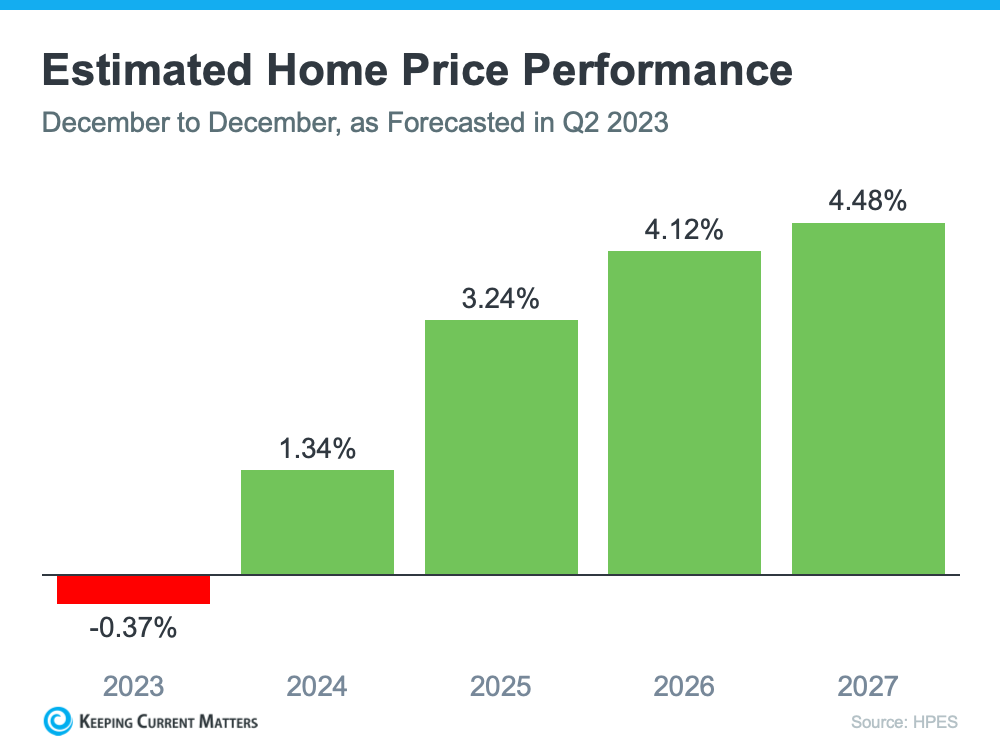
According to the latest release, the experts surveyed are projecting slight depreciation this year (see the red in the graph below). But here’s the context you need most. The worst home price declines are already behind us, and prices are actually appreciating again in many markets. Not to mention, the small 0.37% depreciation HPES is showing for 2023 is far from the crash some people originally said would happen.

Now, let’s look to the future. The green in the graph below shows prices have turned a corner and are expected to appreciate in 2024 and beyond. After this year, the HPES is forecasting home price appreciation returning to more normal levels for the next several years.

So, why does this matter to you? It means your home will likely grow in value and you should gain home equity in the years ahead, but only if you buy now. If you wait, based on these forecasts, the home will only cost you more later on.  

2. Where Do I Think Mortgage Rates Are Heading?

Over the past year, mortgage rates have risen in response to economic uncertainty, inflation, and more. We know based on the latest reports that inflation, while still high, has moderated from its peak. This is an encouraging sign for the market and for mortgage rates. Here’s why.

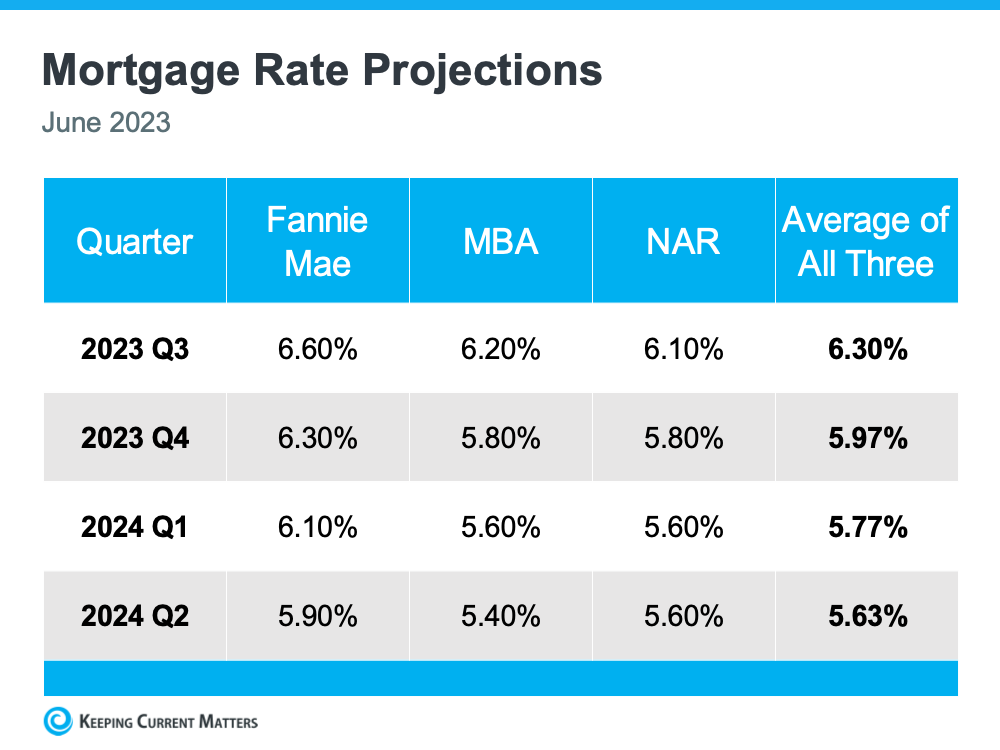
When inflation cools, mortgage rates generally fall in response. This may be why some expertsare saying mortgage rates will pull back slightly over the next few quarters and settle somewhere around roughly 5.5 and 6% on average.

But, not even the experts can say with absolute certainty where mortgage rates will be next year, or even next month. That’s because there are so many factors that can impact what happens. So, to give you a lens into the various possible outcomes, here’s what you should consider:

  • If you buy now and mortgage rates don’t change: You made a good move since home prices are projected to grow with time, so at least you beat rising prices.
  • If you buy now and mortgage rates fall (as projected): You probably still made a good decision because you got the house before home prices appreciated more. And, you can always refinance your home later on if rates are lower.
  • If you buy now and mortgage rates rise: If this happens, you made a great decision because you bought before both the price of the home and the mortgage rate went up.

Bottom Line

If you’re thinking about buying a home, you need to know what’s expected with home prices and mortgage rates. While no one can say for certain where they’ll go, expert projections can give you powerful information to keep you informed. Lean on a trusted real estate professional who can add in an expert opinion on your local market.

Tuesday, July 11, 2023

Where Do I Invest After I’ve Maxed Out My 401(k)?


1. Invest in a traditional or Roth IRA.

2. Open a brokerage account.

3. Buy real estate.

4. Take advantage of your HSA.


For all the details: read the article here

Friday, July 7, 2023

Filter Out the Noise (3 Min Read)

From Jay Papasan

 July 07, 2023

“In rowing as in life, there are competitors and there are racers. The competitor works hard and rows to his limit. The racer does not think of limits, only the race.”
– Jim Dietz

Filter Out the Noise

Olympic rowing is Great Britain’s most successful event. From 1900, when the sport debuted, to 2020, the Brits have medalled 70 times, including 31 gold medals. But coming into the 2000 Sydney Olympics, one boat was in a slump – the men’s eight. The crew hadn’t won gold since repeating as champions in 1908 (London) and 1912 (Stockholm.) They hadn’t made the podium since taking silver in 1980 (Moscow). No one expected them to medal, much less earn gold.

“We realized that if we continued to do what we’d done for the previous however many years,” stated British rower Ben Hunt-Davis, “we’d continue to get the same results.”

They chose to pivot and take a new approach. They started asking a simple question around everything they did in the two years they trained for the Olympics: “Will it make the boat go faster?”

Should we go to the pub after practice? Should I stay up late? Should we do another round of 500 meters on the rowing machines? Should I read this book or watch this show? All these questions found their answer in another question: “Will it make the boat go faster?” Often the answer was obvious.

The 2000 men's rowing crew would win gold in the Sydney Olympics despite years of disappointing results. They won gold using a simple question to filter out the noise. Anything that didn’t make the boat go faster was cast aside. Anything that made the boat go faster became their focus.

My son Gus rowed in high school and competed in men’s eights. For the crew of an eight to compete, they must operate in perfect harmony. The coxswain steers, cheers, and coaches from a seat in the stern. The second oar, the “stroke,” sets the tempo. All eight oars must leave and enter the water in unison. Shoulders and legs synchronized to pull evenly. All this over a 2,000-meter course. None of this is possible without endless hours of grueling training. And every rower must match the commitment of others for the boat to achieve “swing” in a race. Swing happens when everyone is rowing in such perfect harmony that not a single stroke is out of sync. It’s rare. It’s how gold medals are won. In the case of the 2000 British team, they achieved swing through two years of asking and answering “Will this make the boat go faster?”

A great question can serve as a compass for how you invest your time. Will this get me closer to my goal? Does this align with my values? Will this make me stronger? These “compass questions” work for individuals, teams, and companies with a clear, singular priority. When we lack clarity or a true north priority, we can justify any course of action. Robert Brault put it well when he wrote, “We are kept from our goal not by obstacles but by a clear path to a lesser goal.”

The first step is always clarity. What’s your ONE Thing? The next is to craft a compass question to filter out the noise and stay focused on what matters.

One question to ponder in your thinking time: How can I build the habit of asking my compass question to stay on track?

Make an Impact!
Jay Papasan